Casting as Manufacturing Technique
What is Casting ?
Casting is a manufacturing process in which a liquid material is usually poured into a mold, which contains a hollow cavity of the desired shape, and then allowed to solidify. The solidified part is also known as a casting, which is ejected or broken out of the mold to complete the process. Casting materials are usually metals or various time setting materials that cure after mixing two or more components together; examples are epoxy, concrete, plaster and clay. Casting is most often used for making complex shapes that would be otherwise difficult or uneconomical to make by other methods. Heavy equipment like machine tool beds, ships' propellers, etc. can be cast easily in the required size, rather than fabricating by joining several small pieces
 |
| (figure : Schematic of Sand Casting) |
1) Sand Casting:
Sand casting typically relies on silica-based materials, such as synthetic or naturally-bonded sand. Casting sand generally consists of finely ground, spherical grains that can be tightly packed together into a smooth molding surface. The casting is designed to reduce the potential for tearing, cracking, or other flaws by allowing a moderate degree of flexibility and shrinkage during the cooling phase of the process. The sand can also be strengthened with the addition of clay, which helps the particles bond more closely. Automotive products such as engine blocks are manufactured through sand casting.
Sand casting involves several steps, including patternmaking, molding, melting and pouring, and cleaning. The pattern is the form around which the sand is packed, usually in two parts, the cope and the drag. After the sand is compacted enough to replicate the pattern, the cope is removed and the pattern extracted. Then, any additional inserts called core boxes are installed and the cope is replaced. After the metal has been poured and solidified, the casting is removed, trimmed of the risers and gates that were used in the pouring process, and cleaned of any adhered sand and scale.
Sand casting's main advantages as a casting process include:
- Relatively inexpensive production costs, especially in low-volume runs.
- The ability to fabricate large components.
- A capacity for casting both ferrous and non-ferrous materials.
- A low cost for post-casting tooling.
Despite its benefits, sand casting yields a lower degree of accuracy than do alternate methods and it can be difficult to sand cast components with a predetermined size and weight specifications. Furthermore, this process has a tendency to yield products with a comparatively rough surface finish.
 |
| (figure : Schematic of Investment Casting) |
2) Investment Casting:
Investment, or lost-wax, casting uses a disposable wax pattern for each cast part. The wax is injected directly into a mold, removed, then coated with refractory material and a binding agent, usually in several stages to build up a thick shell. Multiple patterns are assembled onto common sprues. Once the shells have hardened the patterns are inverted and heated in ovens to remove the wax. Molten metal is then poured into the remaining shells where it hardens into the shape of the wax patterns. The refractory shell is broken away to reveal the completed casting. Investment casting is often used to manufacture parts for the automotive, power generation, and aerospace industries, such as turbine blades. Some of the central advantages and disadvantages of investment casting include:
- A high degree of accuracy and precise dimensional results.
- The ability to create thin-walled parts with complex geometries.
- The capacity for casting both ferrous and non-ferrous materials.
- Relatively high-quality surface finish and detail in final components.
Although it is highly precise, investment casting is usually more expensive than other comparable casting techniques and is typically only cost-efficient when sand or plaster castings cannot be used. However, the expense can sometimes be compensated for with reduced machining and tooling costs due to investment castings’ quality surface results.
 |
| (figure : Schematic of Die Casting) |
3) Die Casting:
Die casting is a method of molding materials under high pressure and usually involves non-ferrous metals and alloys, such as zinc, tin, copper, and aluminum. The reusable mold is coated with a lubricant to help regulate the die’s temperature and to assist with component ejection. Molten metal is then injected into the die under high pressure, which remains continuous until the workpiece solidifies. This pressurized insertion is rapid, preventing any segment of the material from hardening before being cast. After the process is completed, the component is taken out of the die and any scrap material is removed. A few of the major advantages provided by die casting include:
- Close size and shape tolerances.
- High component dimensional consistency and uniform design.
- A reduced need for post-casting machining.
Despite its advantages, die casting as a metal casting process has relatively high tool costs, making it more cost-efficient in high-volume product runs. It can also be difficult to ensure the mechanical properties of a die-cast component, meaning these products usually do not function as structural parts. As the molds are typically two-piece, die casting is limited to products that can be removed from the mold without destroying the mold, as is done in other casting processes.
 |
| (figure : Engine components made by LPD Casting) |
4) Low-Pressure Die Casting:
Low-pressure die casting is a method of production that uses pressure – rather than gravity to fill molds with molten metal such as aluminum and magnesium. In this process, the holding furnace is located below the cast and the liquid metal is forced upwards through a riser tube and into the cavity. The pressure is applied constantly, sometimes in increasing increments, to fill the mold and hold the metal in place within the die until it solidifies. Once the cast has solidified, the pressure is released and any residual liquid in the tube or cavity flows back into the holding furnace for “recycling.” When cooled, the cast is simply removed.
This method allows precise control of the filling process. Injecting the molten metal in this way reduces oxide formation and reduces porosity, ensuring superior consistency from top to bottom. As such, low pressure casting results in exceptional density and strength values as well as excellent dimensional accuracy. While this method is greatly suited to simpler, symmetrical forms, more complex geometries can be achieved with the use of sand cores within the molds. With the advantage of uncomplicated machinery and technology, the low pressure die casting process lends itself well to automation.
The automotive industry has relied upon low-pressure die casting for decades to create strong, high-quality aluminum casts. However, due to its relatively slow casting process, its use was primarily limited to the luxury class of the automotive market, where lower quantities and higher costs are expected. Now, though, having successfully sought out ways to make this method more cost-effective (e.g. making the machines larger overall, but space-saving due to their vertical construction), the automotive industry has decreased the time of the casting cycle by 50%, making low-pressure casting a far more economical choice than it once was.
Although low-pressure casting is an exceptional choice for automotive components such as engine blocks, wheels, and suspension parts, non-automotive industries such as electronics, machine-building, and pipe assemblies also benefit from its lower machining costs, high volume yield, and exceptional metallurgic quality. Cast aluminum’s superior electrical and thermal conductivity make it a very desirable choice for all of these industries.
5) Centrifugal Casting:
Centrifugal casting is a process that delivers components of high material soundness. As a result, it is the technology of choice for applications like jet engine compressor cases, hydro wear rings, many military products, and other high-reliability applications. It has also proven to be a cost-effective means of providing complex shapes with reduced machining requirements and lower manufacturing costs as compared to forgings and fabrications.
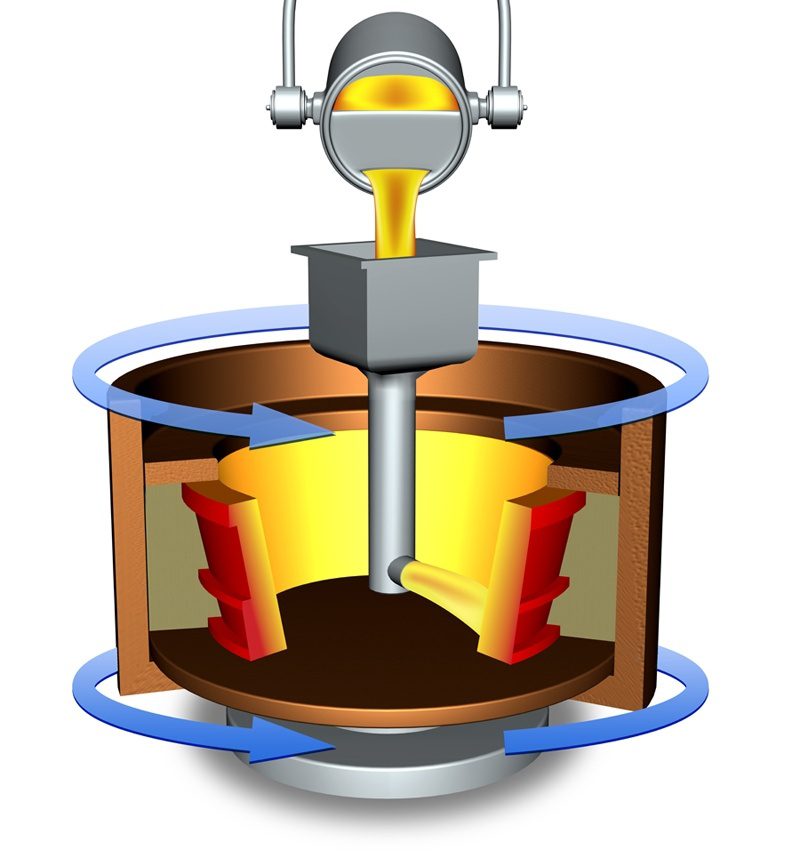
In the centrifugal casting process, molten metal is poured into a preheated, spinning die. The die may be oriented either on a vertical or horizontal axis depending on the configuration of the desired part.
By spinning a mold while the molten metal is poured into it, centrifugal force acts to distribute the molten metal in the mold at pressures approaching 100 times the force of gravity. The combination of this applied pressure and the engineering mechanics of controlled solidification and secondary refining produces components of superior quality.
Vertical Centrifugal Casting
V
 |
| (figure : Vertical Centrifugal Casting) |
Details on the outside surface of the casting may be modified from the true circular shape by the introduction of flanges or bosses to the inner diameter of the mold. The finished part need not be symmetrical but, in some cases, the casting mold does to maintain balance while spinning.
The inside diameter and therefore the wall thickness of the casting are functions of the amount of metal poured into the rotating mold and the quantity machined away. When casting vertically, the height of the casting will typically be less than twice the width.
Horizontal Centrifugal Casting
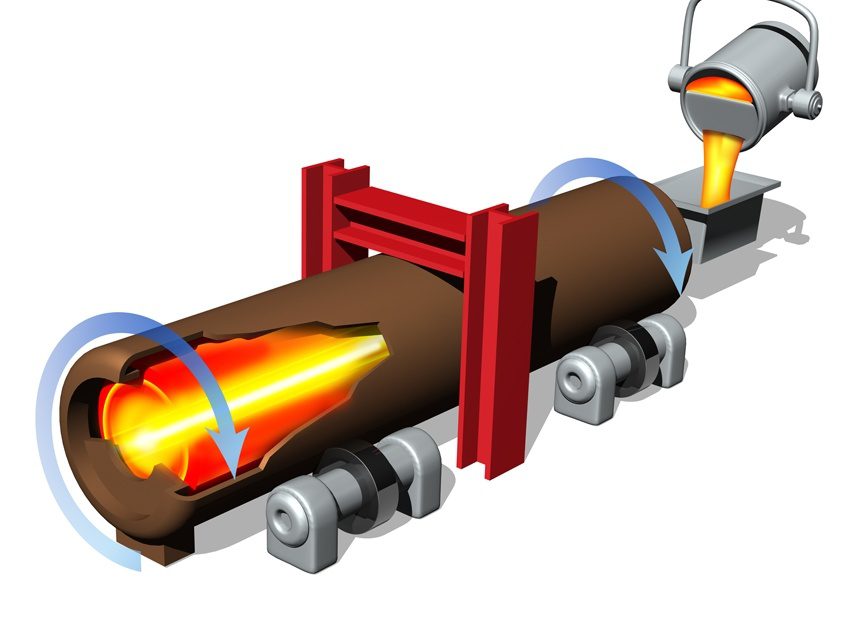
Some centrifugal casters produce only horizontal castings where the die rotates about the horizontal axis. This is a cost-effective method for producing high-quality tubular components.
This process is especially suited for long cylindrical parts where the casting length is significantly longer than its outside diameter. This includes straight tube sections, long cylinders with end flanges, or short parts such as rings or flanges where multiple parts can be machined effectively from a straight cylinder.
 |
| (figure : Ideailzed Model of Horziontal Centrifugal Casting) |
A long steel casting mold is spun at high speed while positioned horizontally. The rotational speed of the mold is high, to offset gravitational forces. Covers are fixed at each end of the mold to contain the molten metal and a pour funnel is used to deliver a specified weight of metal inside the mold.
Just as in vertical casting, the interior dimension of the mold determines the O.D. size of the part, while the amount of metal poured into the mold determines the I.D. size.
Reference List:
For Definition of Casting
https://en.wikipedia.org/wiki/Casting
For Sand and Die Casting
https://www.thomasnet.com/articles/custom-manufacturing-fabricating/types-of-casting-processes/
For Low Pressure Casting:
https://kicastings.com/what-is-low-pressure-die-casting/
For Centrifugal Casting :
https://www.metaltek.com/blog/what-is-centrifugal-casting/
Yorumlar
Yorum Gönder